
This guide is general information, not legal advice. Platform policies and regulations change often, so I check the current Meta, Google, FTC and New York rules before each launch, and your practice's attorney or compliance officer always has the final word.
Compliance-first marketing
The Compliance Guide for Medical Practice Marketing
Marketing built for online stores can cost a practice its ad account and its patients' trust. This is the checklist I run before anything goes live.
The checklist
Seven Areas I Check Before Anything Goes Live
01
Patient data and HIPAA
- Business Associate Agreements. Every tool that stores, sends or processes patient information (texting, email, CRM, call recording, AI assistants) runs under a signed BAA, or never sees patient details.
- Minimum necessary. Marketing systems hold contact details and appointment times, never diagnoses or treatment notes.
- Access control. Unique logins, two-factor authentication, and access removed the day someone leaves the account.
02
Tracking and conversions
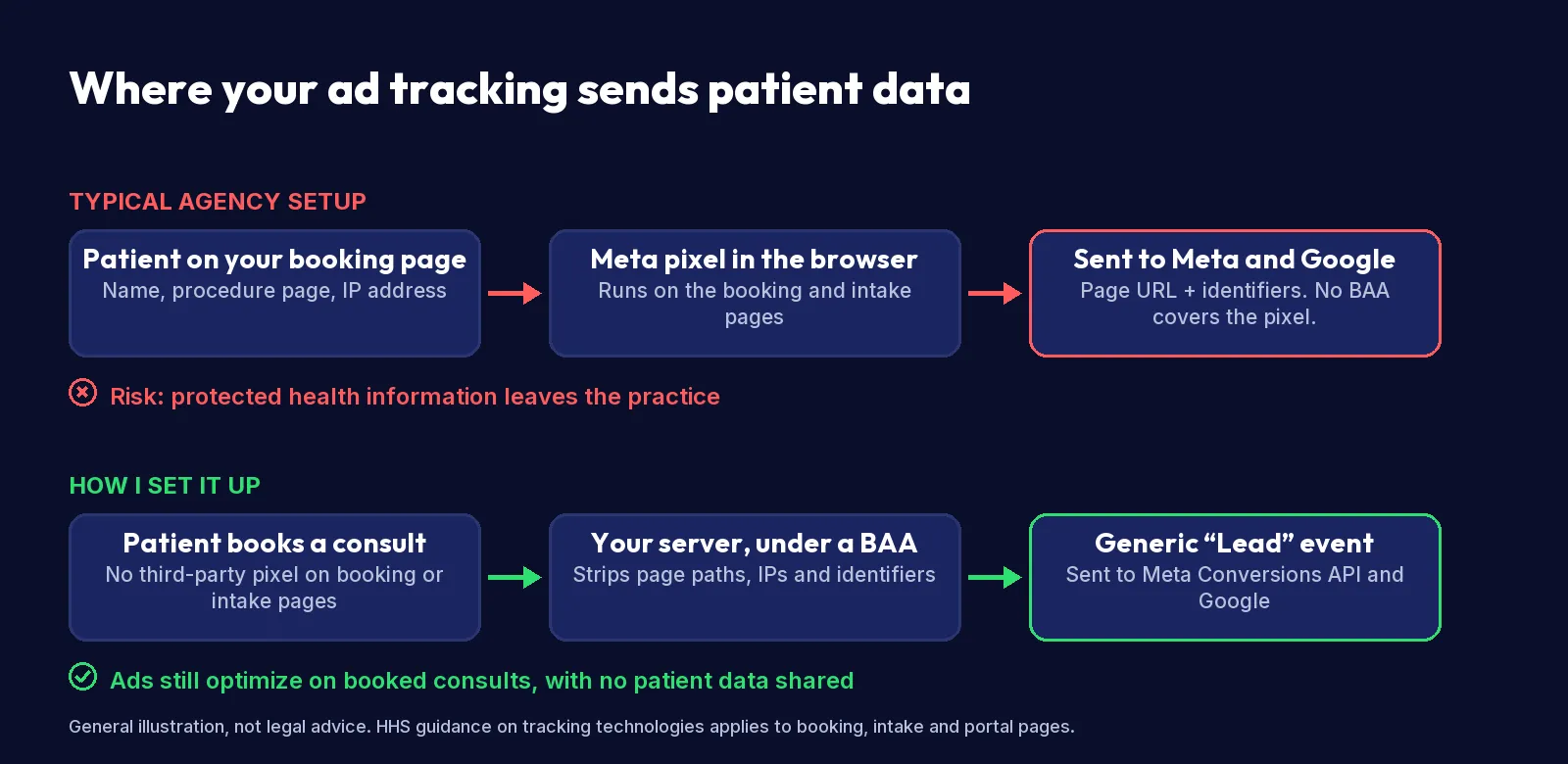
- No pixels on sensitive pages. No Meta, Google or TikTok pixel on booking, intake or patient-portal pages. HHS has warned these pages can disclose protected health information.
- Server-side, PHI-free events. Conversions go through a server covered by a BAA, with page paths and identifiers stripped, then a generic event goes to Meta's Conversions API and Google.
- Honest status. A federal court vacated part of HHS's tracking guidance for public pages in 2024. Booking and intake pages remain high risk, so I treat them that way.
03
Advertising policies
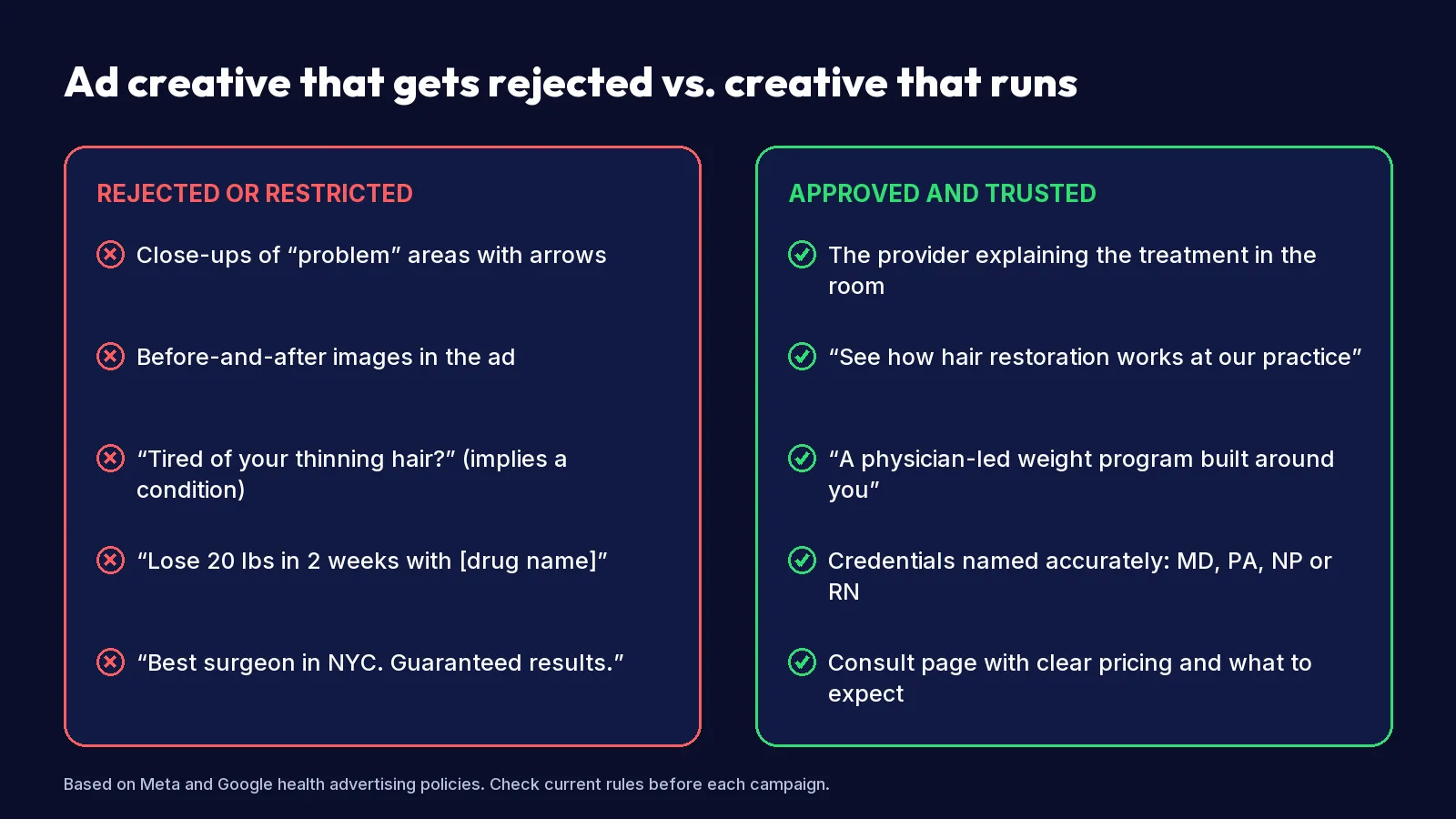
- No implied conditions. Ads talk about the treatment and the practice, never the viewer's body or health.
- Creative that passes review. No close-ups of problem areas, no arrows on wrinkles, no before-and-after in cosmetic or weight loss ads. 18+ targeting where required.
- Prescription drugs. No brand names like Botox or Ozempic, and no GLP-1 ads, without platform certification such as LegitScript.
04
Claims, credentials and the FDA
- Substantiated claims only. No guaranteed results, no "painless" or "best in NYC" unless provable. Results content notes that individual results vary.
- Accurate credentials. Every page and ad names who performs the treatment. A PA, NP or RN is never presented as a doctor or specialist.
- Devices and new treatments. Devices are "FDA-cleared" only for their cleared use. Exosomes, stem cells and research peptides are never marketed as proven.
05
Reviews, testimonials and consent
- Written authorization first. No patient name, photo, video or story in marketing without a signed HIPAA authorization on file.
- Every patient asked. Review requests go to every patient the same way. No review gating, no fake or incentivized reviews (FTC Consumer Review Rule).
- Safe replies. Review replies never confirm that someone is a patient or mention treatment.
06
Texting, email and memberships
- Consent and registration. Marketing texts need prior express written consent (TCPA), run through A2P 10DLC registration, and honor STOP instantly. Emails follow CAN-SPAM.
- Neutral messages. Reminders and rebooking texts never name the drug or treatment. "Your 3-month touch-up", not the product.
- Clear memberships. Price, renewal terms and an easy way to cancel are shown before anyone joins, as New York's automatic renewal law requires.
07
Business structure
- A flat fee. I charge a flat monthly fee, never a percentage of patient revenue or a fee per patient, the structure New York's fee-splitting rules point to.
- Clinical decisions stay clinical. Marketing never implies that non-licensed staff decide on or perform medical treatment (corporate practice of medicine).
- You own everything. Every account, page, video and automation belongs to the practice from day one.
Advertising
What Gets Rejected, and What Runs
Common Compliance Questions
Can a medical practice post patient reviews and before-and-after photos?
Yes, with the patient's written HIPAA authorization on file before anything is posted. Use real, unedited photos with consistent lighting and angles, note that individual results vary, and never add details the patient did not agree to share. A verbal OK in the consult room is not enough.
Why do Meta ads for med practices get rejected?
Usually because the ad implies the viewer has a health condition, such as asking if they are tired of their hair loss. Meta's personal health policy does not allow that. Ads that describe the treatment and the practice, are set to 18 and older for cosmetic and weight loss topics, and avoid before-and-after images and close-ups of problem areas usually pass.
Can a weight loss clinic advertise semaglutide or other GLP-1 drugs?
Advertising prescription drugs on Google or Meta requires platform authorization, usually through LegitScript certification. Most clinics are better off advertising the program, the provider and the care plan without naming the drug, and checking each platform's current policy before launching.
Is it a HIPAA problem to have a Meta or Google pixel on our booking page?
It can be. HHS warned in 2022 and again in 2024 that tracking pixels on pages where patients book or share health details can disclose protected health information, and a federal court vacated part of that guidance in 2024 for public pages. The safe setup is no third-party pixels on booking or intake pages and PHI-free conversion events sent from the server.
How should a practice reply to a negative Google review?
Never confirm the reviewer is a patient or mention any treatment, even to correct the record. HHS has fined practices for disclosing patient information in review replies. Thank them, say you take every concern seriously, and invite them to call the office so the conversation moves offline.
Can we say our laser or RF microneedling device is FDA-approved?
Usually not. Most aesthetic devices are FDA-cleared through the 510(k) process, not FDA-approved. Say FDA-cleared, and only for the use it was cleared for. Promoting a device beyond its cleared use is a misleading claim.
Can a longevity clinic advertise exosomes, stem cells or peptides?
Be very careful. The FDA has warned that no exosome products are approved, has sent warning letters over unapproved stem cell treatments, and in 2023 flagged peptides like BPC-157 as raising significant safety risks for compounding. Do not market them as proven or approved; advertise the physician, the evaluation and the care plan instead.
What claims can a longevity clinic make?
Describe what you measure and what the visit includes. Claims like reverses aging, adds years to your life or prevents disease need solid scientific evidence under FTC rules, and the FTC has sued an IV therapy company over claims it could not back up. Memberships also need clear pricing and an easy way to cancel under New York's automatic renewal law.
Can a medical practice use the Meta pixel and Conversions API?
Not the standard pixel on booking, intake or portal pages: Meta doesn't sign a BAA for it, and those pages can reveal health information. The safer setup sends conversions server-side, through a system covered by a BAA, with page paths and identifiers stripped, so ads still optimize on booked consults.
Can a marketing agency charge a percentage of practice revenue?
It's risky in New York. Sharing fees for professional services with non-licensed parties can be treated as professional misconduct, so percentage-of-revenue or per-patient deals can look like fee-splitting. A flat monthly fee for marketing services is the safer structure. Have the practice's healthcare attorney review any arrangement.
Do ads have to say who performs the treatment?
They must not mislead about it. Calling a physician assistant, nurse practitioner or nurse a doctor or specialist, or implying a physician performs a service they don't, is misleading advertising under New York professional rules and FTC law. Name the provider and their credential accurately.
Is it okay to only ask happy patients for Google reviews?
No. Selectively asking only happy customers is review gating, which Google's policies prohibit, and the FTC's Consumer Review Rule bans suppressing negative reviews. Send every patient the same request and give everyone a private way to reach you if something went wrong.
See Exactly Where Your Practice Loses Consults
Book one of 5 free Marketing Reviews this month. I run your scan before we talk, then walk you through what it found and the fixes ranked by revenue. Only for aesthetic, weight loss and longevity practices.
Get My Free Marketing Review